This summer we have been working on an extendable table for a dining room. The table, made mainly of American oak, opens in the middle so that an insert can be added, extending it by about 50 cm.
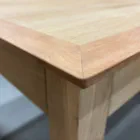

This summer we have been working on an extendable table for a dining room. The table, made mainly of American oak, opens in the middle so that an insert can be added, extending it by about 50 cm.

Last days, I discovered that old grinding belts are prone to break by the scarf joint. This is an annoying but solvable issue.

Last summer, I spent some time designing and building a few cabinets to store my materials under the workbench. I hadn’t found the time to write about it until now, but in this post, I will share some details of the build.

During the last months I’ve been helping Luke Rickert —of Elisenberg Engineering— to move forward a foundry project. I had a limited experience on foundry business that comes from the rebuilding of a cabinet saw and Luke’s project became a really interesting experience.
All begins when Luke asked me about foundries in Catalonia. He currently lives in southern France and he is really close to catalan speaking lands.
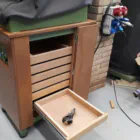
One of my projects this summer was to finish the cabinet for the Wörner B13 drill press. The work mainly consisted of cladding the steel support frame with MDF. The ultimate goal was to prepare it for the electrical wiring and a set of drawers to organize the machine’s tooling.

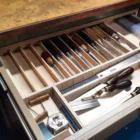
The Leinen LZ4SB lathe cabinet has a drawer that is usually used to store the collets set. This requires to make a wood support to organize the set. I want also to store some usual tools: some live and dead centers and the wrenches needed to operate the lathe.